
Bipolar ADHD is a term used to describe people who have both bipolar disorder and attention deficit hyperactivity disorder (ADHD). Bipolar disorder is a mental health condition that causes extreme mood swings, ranging from mania to depression. ADHD is a neurodevelopmental disorder that affects attention, behavior, and impulse control.
Symptoms of Bipolar ADHD
The symptoms of bipolar ADHD can vary from person to person, but some common symptoms include:
- Mood swings: People with bipolar ADHD may experience extreme mood swings, ranging from mania to depression. During a manic episode, they may feel energized, euphoric, and impulsive. During a depressive episode, they may feel sad, hopeless, and unmotivated.
- Inattention: People with ADHD have difficulty paying attention and staying focused on tasks. They may be easily distracted and forgetful.
- Hyperactivity: People with ADHD may be hyperactive and restless. They may have difficulty sitting still and may have trouble controlling their energy levels.
- Impulsivity: People with ADHD may act impulsively without thinking about the consequences of their actions. They may make rash decisions and engage in risky behaviors.
Diagnosis of Bipolar ADHD
Bipolar ADHD can be difficult to diagnose because the symptoms of the two conditions can overlap. A mental health professional will typically conduct a comprehensive evaluation, including a physical exam, interview, and psychological tests.
Treatment of Bipolar ADHD
The treatment of bipolar ADHD typically involves a combination of medication and therapy. Medication can help to stabilize mood and improve attention and behavior. Therapy can help people to learn coping skills and strategies for managing their symptoms.
Living with Bipolar ADHD
Living with bipolar ADHD can be challenging, but it is possible to manage the symptoms and live a fulfilling life. There are a number of things that people with bipolar ADHD can do to manage their condition, such as:
- Taking medication as prescribed
- Attending therapy regularly
- Getting enough sleep
- Eating a healthy diet
- Exercising regularly
- Avoiding alcohol and drugs
- Developing a support system of friends and family
Comorbidity
Bipolar ADHD is often comorbid with other mental health conditions, such as anxiety disorders, substance abuse disorders, and learning disabilities. It is important to treat all comorbid conditions in order to improve overall quality of life.
Prognosis
The prognosis for people with bipolar ADHD is generally good with treatment. However, it is important to note that bipolar disorder is a chronic condition, and people will need to manage their symptoms throughout their lives.
Challenges of Bipolar ADHD
People with bipolar ADHD face a number of challenges, including:
- Managing mood swings: The extreme mood swings of bipolar disorder can be disruptive to relationships, work, and school.
- Coping with inattention and hyperactivity: The symptoms of ADHD can make it difficult to focus on tasks, complete assignments, and stay organized.
- Controlling impulsivity: The impulsivity of ADHD can lead to risky behaviors, such as substance abuse and gambling.
- Dealing with the stigma of mental illness: Mental illness can be stigmatized in society, which can make it difficult for people with bipolar ADHD to get the support they need.
Tips for Managing Bipolar ADHD
There are a number of things that people with bipolar ADHD can do to manage their condition, including:
- Take medication as prescribed: Medication can help to stabilize mood and improve attention and behavior. It is important to take medication as prescribed by a doctor, even when feeling well.
- Attend therapy regularly: Therapy can help people to learn coping skills and strategies for managing their symptoms. It is important to find a therapist who is experienced in treating bipolar ADHD.
- Get enough sleep: Sleep is essential for managing bipolar disorder and ADHD. People with bipolar ADHD should aim for 7-8 hours of sleep each night.
- Eat a healthy diet: Eating a healthy diet can help to improve mood and energy levels. People with bipolar ADHD should avoid processed foods, sugary drinks, and excessive caffeine and alcohol.
- Exercise regularly: Exercise is a great way to improve mood and energy levels. People with bipolar ADHD should aim for at least 30 minutes of moderate-intensity exercise most days of the week.
- Avoid alcohol and drugs: Alcohol and drugs can worsen the symptoms of bipolar disorder and ADHD. People with bipolar ADHD should avoid alcohol and drugs altogether.
- Develop a support system of friends and family: Having a support system of friends and family can be helpful for people with bipolar ADHD. People with bipolar ADHD should talk to their loved ones about their condition and let them know how they can help.
If you or someone you know has bipolar ADHD,
WebJustin Paget/DigitalVision/Getty. Attention-deficit/hyperactivity disorder (ADHD) and bipolar disorder are two diagnoses in the Diagnostic and Statistical Manual of Mental. WebThe primary difference between ADHD and bipolar is in the main symptoms. Bipolar disorder is a mood disorder, while ADHD is a neurodevelopmental condition that affects. WebBipolar disorder, formerly called manic depression, is a mental health condition that causes extreme mood swings that include emotional highs (mania or hypomania) and lows. WebAlthough ADHD and bipolar disorder can share some symptoms, they are different conditions, and a person can have both of them. Learn about the differences and how. WebIn adulthood, a correct differential diagnosis between BD and ADHD, is pivotal, because irritability, inattention and hyperactivity improve with specific medications, and patients. WebIn this article, you will learn about the differences between ADHD and bipolar disorder. Bipolar disorder is a serious condition whose symptoms will worsen if not diagnosed,.
Bipolar Disorder vs ADHD: A Common Misdiagnosis & Do They Overlap | MedCircle
Source: Youtube.com
ADHD and Bipolar Disorder - New Insights from Patient Research , ADHD in Adults

Source: Youtube.com
What Is Bipolar Adhd, Bipolar Disorder vs ADHD: A Common Misdiagnosis & Do They Overlap | MedCircle, 22.64 MB, 16:29, 98,351, MedCircle, 2021-04-08T18:00:14.000000Z, 2, Bipolar vs ADHD, 607 x 1080, jpg, , 3, what-is-bipolar-adhd
What Is Bipolar Adhd. WebBipolar disorder is a mental health condition characterized by changes in thoughts, mood, and behavior. A person with bipolar disorder may experience periods of mania, hypomania, and depressive episodes. Attention deficit hyperactivity disorder (ADHD) is. WebADHD and bipolar disorder often occur together. Some symptoms, such as impulsivity and inattention, can overlap. This can sometimes make them difficult to tell apart. It's still. Web3. ADHD and Bipolar Disorder. Bipolar disorder (BD) is characterized by the alternation of mood episodes and variable periods of euthymia, which lead to worse overall functioning.
Claim one week of free access to the MedCircle library for exclusive Live Classes like this one: watch.medcircle.com/medcircle-live
Bipolar disorder (formerly manic depression) can often look like ADHD and vice versa. Episodes of mania and hyperactivity often get confused. In this video, discover the truth behind bipolar disorder vs ADHD - why is it such a common misdiagnosis, and do they overlap?
The education doesn't end here. Discover more on bipolar disorder, ADHD, and other mental health symptoms most people miss with Dr. Dom at the links below.
In this discussion, double board-certified psychiatrist Dr. Dom Sportelli and MedCircle Host Kyle Kittleson answer...
- Can the symptoms of bipolar disorder mimic those of ADHD, or vice versa?
Why is this?
Do these disorders co-occur or overlap?
Who is most likely to experience both of these disorders? Why?
How can someone correctly differentiate between ADHD behavior and bipolar disorder behavior?
Does ADHD medication play a role?
How can someone find the right treatment for bipolar disorder and ADHD?
Watch Dr. Dom's full series on bipolar disorder HERE: watch.medcircle.com/bipolar-disorder-101
It answers questions like -
What is bipolar disorder in the first place?
What does a bipolar disorder manic episode and bipolar depression look like?
He also has a full series on ADHD in children, teenagers and adults: watch.medcircle.com/navigating-adhd
It includes -
Whether ADHD mimic other mood disorders like anxiety or depression or vice versa
What ADHD actually looks like in the brain
What an ADHD test looks like & how a doctor reaches an ADHD diagnosis
Options for ADHD treatment & ADHD medication
Other options for ADHD help
A full breakdown of the symptoms of ADHD and how to spot them
ADD vs ADHD
#BipolarDisorder #ADHD #MedCircle
*MedCircle is not a referral service and does not recommend, endorse, discourage, screen, or approve any providers, medical procedures, products, or services; nor does MedCircle provide medical advice of any kind. This information is not specific medical advice and does not replace information you receive from your healthcare provider. You must talk with your healthcare provider for complete information about your health and treatment options. Only your healthcare provider has the knowledge and training to provide advice that is right for you.
What Is Bipolar Adhd, WebAlthough ADHD and bipolar disorder can share some symptoms, they are different conditions, and a person can have both of them. Learn about the differences and how. WebIn adulthood, a correct differential diagnosis between BD and ADHD, is pivotal, because irritability, inattention and hyperactivity improve with specific medications, and patients. WebIn this article, you will learn about the differences between ADHD and bipolar disorder. Bipolar disorder is a serious condition whose symptoms will worsen if not diagnosed,.
Bipolar vs ADHD - Source: Neurodivergent Insights
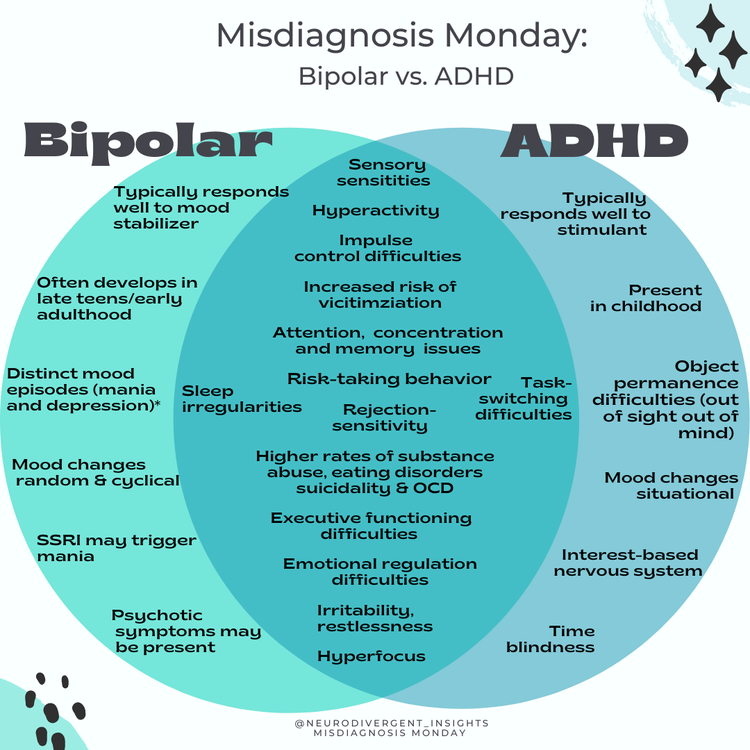
Bipolar vs ADHD - Source: neurodivergentinsights.com

ADHD and Bipolar Disorder in Children | APSARD - Source: APSARD
Is bipolar associated with adhd
Is bipolar associated with adhd What is the difference between bipolar and adhd in adults.
What is the difference between bipolar and adhd in adults polar-and-adhd-5210966Relationship Between Bipolar and ADHD - Verywell Health
What is the difference between bipolar and adhd in adults Bipolar disorder, previously called manic depression, is a mental illness characterized by: Manic episodes, or periods of "high moods," in which a person becomes extremely energized and active, often in scattered, unproductive, and potentially dangerous ways. Symptoms may include irritability, sleep deprivation, and thinking that is out-of , What is the difference between bipolar and adhd.
What is the difference between bipolar and adhd
What is the difference between bipolar and adhd What is worse bipolar or adhd.
What is worse bipolar or adhd
What is worse bipolar or adhd What is bipolar adhd.
What is bipolar adhd
What is bipolar adhd What is worse bipolar or adhd.
ar-disorder-adhd-puzzleBipolar and ADHD...Together? An Expert Explains The Signs
Bipolar disorder often co-occurs with ADHD in adults, with comorbidity rates estimated between 5.1 and 47.1 percent 1. Recent research, however, suggests that about 1 in 13 patients with ADHD has comorbid BD, and up to 1 in 6 patients with BD has comorbid ADHD 2. The tragedy is that, when the disorders co-occur, the diagnoses are often missed. .
.
childhood-adhdBipolar Disorder or ADHD? How to Tell the Difference - WebMD
Bipolar disorder is primarily a mood disorder. ADHD affects attention and behavior; it causes symptoms of inattention, hyperactivity, and impulsivity. While ADHD is chronic or ongoing, bipolar , .
.
.
.
r-or-adhdBipolar Disorder or ADHD: What's the Difference? - Healthline
Bipolar disorder and attention deficit hyperactivity disorder (ADHD) are conditions that affect many people. Some of the symptoms even overlap. This can sometimes make it difficult to tell the , .
vs-bipolar-a-guide-toADHD vs Bipolar: Guide to Distinguishing Lookalike Conditions
ADHD is far more common than bipolar disorder. (About 9% of all children in the U.S. have symptoms of ADHD 3; many of those children grow up to become adults with ADHD. Bipolar disorder, in contrast, impacts just 2.4 percent of the population. 4) As such, physicians are more likely to recognize and screen for ADHD. Is adhd a symptom of bipolar.
Is adhd a symptom of bipolar or-bipolar-disorder-20589How to Tell ADHD and Bipolar Disorder Apart - Verywell Mind
Is adhd a symptom of bipolar For example, both conditions can cause hyperactive or restless behaviors, distractibility, poor concentration, impulsivity, and racing thoughts. ADHD and bipolar disorder can also lead to sleep disturbances, poor social relationships, feelings of anxiety, depression, frustration, and self-doubt. Both conditions can significantly affect a person , Does bipolar come with adhd.
Does bipolar come with adhd › adhdADHD and Bipolar Disorder: Diagnosis, Treatment, and More
Does bipolar come with adhd Is bipolar associated with adhd.


0 Comments