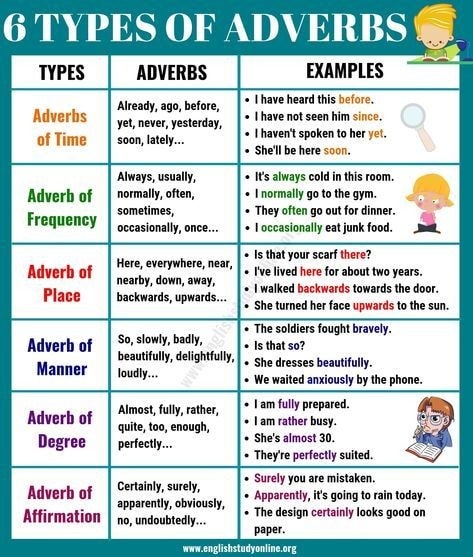
An adverb whole is a word that modifies an entire sentence or clause. It is also known as a sentence adverb. Adverbs whole can be used to express a viewpoint, make an evaluation, or add emphasis to a sentence. They are often placed at the beginning or end of a sentence, and they are typically set off with commas.
Here are some examples of adverb wholes:
- Fortunately, I had brought an umbrella.
- Unfortunately, the meeting was canceled.
- Honestly, I don't know what to say.
- Clearly, she is not happy.
- Seriously, you need to stop.
How to Use Adverbs Whole
Adverbs whole can be used to add variety and interest to your writing. They can also be used to make your writing more concise and to the point. However, it is important to use adverbs whole sparingly, as overuse can make your writing sound cluttered and unprofessional.
Here are some tips for using adverbs whole effectively:
- Use them to express a viewpoint or make an evaluation. For example: Fortunately, I had brought an umbrella.
- Use them to add emphasis to a sentence. For example: Seriously, you need to stop.
- Use them to make your writing more concise and to the point. For example: Obviously, this is the best solution.
- Avoid using them to modify verbs, adjectives, or other adverbs. This can make your writing sound redundant. For example: The meeting was obviously canceled.
Examples of Adverbs Whole in Sentences
Here are some more examples of adverbs whole in sentences:
- Generally speaking, the economy is doing well.
- In all fairness, he didn't do anything wrong.
- To be honest, I'm not sure what to think.
- Strictly speaking, that's not true.
- Technically speaking, we're not allowed to do that.
Adverbs Whole and Tone
Adverbs whole can be used to convey a variety of different tones, including:
- Formal:Obviously, this is the best solution.
- Informal:Honestly, I don't know what to say.
- Subjective:Clearly, she is not happy.
- Objective:Statistically speaking, the chances of that happening are very slim.
- Emphatic:Seriously, you need to stop.
Using Adverbs Whole to Improve Your Writing
Adverbs whole can be a valuable tool for improving your writing. By using them effectively, you can add variety and interest to your writing, make your writing more concise and to the point, and convey a variety of different tones.
Here are some tips for using adverbs whole to improve your writing:
- Use them sparingly. Overuse of adverbs whole can make your writing sound cluttered and unprofessional.
- Use them to express a viewpoint or make an evaluation. This is a great way to add your own unique voice to your writing.
- Use them to add emphasis to a sentence. This can be helpful for making a point or getting your reader's attention.
- Use them to make your writing more concise and to the point. This can be especially helpful in academic or business writing.
- Choose the right adverb whole for the tone you want to convey. For example, if you want to sound formal, you might use an adverb whole like "obviously" or "technically speaking." If you want to sound informal, you might use an adverb whole like "honestly" or "seriously."
Conclusion
Adverbs whole are a versatile tool that can be used to improve your writing in a variety of ways. By using them effectively, you can add variety and interest to your writing, make your writing more concise and to the point, and convey a variety of different tones.
HTML Format and Tags
Here is the HTML format and tags for the blog post above, without the <html>, <head>, and <body> tags:
An adverb whole is a word that modifies an entire sentence or clause. It is also known as a sentence adverb. Adverbs whole can be used to express a viewpoint, make an evaluation, or add emphasis to a sentence. They are often placed at the beginning or end of a sentence, and they are typically set off with commas. Here are some examples of adverb wholes: * **Fortunately,** I had brought an umbrella. * **Unfortunately,** the meeting was canceled. * **Honestly,** I don't know what to say. * **Clearly,** she is not happy. * **Seriously,** you need to stop. ## How to Use Adverbs Whole Adverbs whole can be used to add variety and interest WebSee whole in the Oxford Advanced American Dictionary. Check pronunciation: whole. Definition of whole_3 adverb in Oxford Advanced Learner's Dictionary. Meaning,. WebRevised on February 7, 2023. An adverb is a word that can modify or describe a verb, adjective, another adverb, or entire sentence. Adverbs can be used to. WebDefinition of whole_3 adverb in Oxford Advanced American Dictionary. Meaning, pronunciation, picture, example sentences, grammar, usage notes, synonyms and more. WebWe use the whole or the whole of to refer to complete single things and events that are countable and defined:. WebYes it can be an adverb - just not in your example sentence. An adverb is a word or phrase that modifies or qualifies an adjective, verb, or other adverb. In your.
Parts of Speech for Kids: What is an Adverb
Source: Youtube.com
Adverbs | Adverb Song | Grammar Song for Children | What is an Adverb | Grammar

Source: Youtube.com
What Is Adverb Whole, Parts of Speech for Kids: What is an Adverb, 6.66 MB, 04:51, 1,924,509, Teaching Without Frills, 2019-04-08T23:50:40.000000Z, 2, KYF Learning School - An adverb is a word that modifies (describes) a verb (he sings loudly), an adjective (very tall), another adverb (ended too quickly), or even a whole sentence (Fortunately,, 557 x 473, jpg, , 3, what-is-adverb-whole
What Is Adverb Whole. WebAdverbs for whole include whole, wholely, wholly and wholy. Find more words at wordhippo.com! WebAdverb . whole (comparative more whole, superlative most whole) In entirety; entirely; wholly. Synonyms: see Thesaurus: completely
In this video, you'll learn all about adverbs!
You will be able to answer the question: "What is an adverb?"
You will be able to find adverbs in a sentence!
And you will be able to add adverbs to a sentence to make it more detailed and interesting!
Teachers: Check out my TPT store for related resources!
teacherspayteachers.com/Store/Teaching-Without-Frills
What Is Adverb Whole, WebWe use the whole or the whole of to refer to complete single things and events that are countable and defined:. WebYes it can be an adverb - just not in your example sentence. An adverb is a word or phrase that modifies or qualifies an adjective, verb, or other adverb. In your.
KYF Learning School - An adverb is a word that modifies (describes) a verb (he sings loudly), an adjective (very tall), another adverb (ended too quickly), or even a whole sentence (Fortunately, - Source: facebook.com

What Are Adverbs In English? Definition, Types, Usage, & Examples - Source: myenglishpages.com

Dana Smile - What are English Adverbs? An adverb describes a verb, an adjective or another adverb. It tells us how, where, when, how much and with what frequency. What are functions - Source: facebook.com
Whole adverb or adjective adverbWhat Is an Adverb? Definition and Examples | Grammarly
Whole adverb or adjective An adverb is a word that modifies (describes) a verb ("he sings loudly"), an adjective ("very tall"), another adverb ("ended too quickly"), or even a whole sentence ("Fortunately, I had brought an umbrella."). What is the adverb of wholesale.
What is the adverb of wholesale
What is the adverb of wholesale What is the adverb of wholeheartedly.
What is the adverb of wholeheartedly
What is the adverb of wholeheartedly What kind of adverb is wholeheartedly.
What kind of adverb is wholeheartedly
What kind of adverb is wholeheartedly What is whole adverb.
What is whole adverb
What is whole adverb What kind of adverb is wholeheartedly.
adverbs_2Adverbs - English Grammar Today - Cambridge Dictionary
We use adverbs to add more information about a verb, an adjective, another adverb, a clause or a whole sentence and, less commonly, about a noun phrase. Can you move it carefully? It's fragile. Quickly! We're late. She swims really well. Don't go so fast. You have to turn it clockwise. Come over here. Actually, I don't know her. .
essons › adverbsAdverbs: Definition and Examples - Grammar Monster
Table of Contents. Learning about Adverbs. Find the Adverb Test. Function of the Adverb Test. Interactive Examples of Adverbs. More about Adverbs. Adverbs Modify Verbs. Adverbs Modify Adjectives. Adverbs Modify Adverbs. Types of Adverb. Adverbial Phrases and Clauses. Video Lesson. Why Adverbs Are Important. Test Time! Learning about Adverbs. .
ntent › grammar-rulesEnglish Grammar Rules - Adverb - Ginger Software
Adverb. What is an Adverb? An adverb is a word that is used to change, modify or qualify several types of words including an adjective, a verb, a clause, another adverb, or any other type of word or phrase, with the exception of determiners and adjectives, that directly modify nouns. .
.
.
.
ies.com › whole_3whole adverb - Definition, pictures, pronunciation and usage ...
Definition of whole adverb in Oxford Advanced American Dictionary. Meaning, pronunciation, picture, example sentences, grammar, usage notes, synonyms and more. .
speech › adverbsWhat Is an Adverb? Definition, Types & Examples - Scribbr
An adverb is a word that can modify or describe a verb, adjective, another adverb, or entire sentence. Adverbs can be used to show manner (how something happens), degree (to what extent), place (where), and time (when). .
What type of adverb is wholly.
What type of adverb is wholly › the-adverb-forWhat is the adverb for whole? - WordHippo
What type of adverb is wholly What's the adverb for whole? Here's the word you're looking for. wholly. Completely and entirely; to the fullest extent. Exclusively and solely. Synonyms: completely, totally, fully, entirely, thoroughly, utterly, absolutely, altogether, perfectly, quite, soundly, exactly, dead, clean, plumb, comprehensively, downright, heartily, all , Whole adverb or adjective.


0 Comments