An adverb is a word that modifies (describes) a verb, an adjective, or another adverb. Adverbs often end in -ly, but some (such as fast) look exactly the same as their adjective counterparts.
Adverbs can answer the following questions:
- How? (manner)
- When? (time)
- Where? (place)
- To what extent? (degree)
Examples:
- The bird sings loudly. (How does the bird sing?)
- I arrived early. (When did I arrive?)
- The cat is under the table. (Where is the cat?)
- I am very happy. (To what extent am I happy?)
Different Types of Adverbs
There are many different types of adverbs, but some of the most common include:
- Adverbs of manner: These adverbs describe how something is done. Examples include quickly, slowly, carefully, loudly, softly, etc.
- Adverbs of time: These adverbs describe when something happens. Examples include now, then, yesterday, today, tomorrow, always, never, etc.
- Adverbs of place: These adverbs describe where something happens. Examples include here, there, there, up, down, inside, outside, etc.
- Adverbs of degree: These adverbs describe how much or to what extent something happens. Examples include very, completely, totally, hardly, barely, etc.
Using Adverbs in Sentences
Adverbs can be placed in different positions in a sentence, but they usually come after the verb they are modifying. For example:
- The bird sings loudly.
- I arrived early.
- The cat is under the table.
- I am very happy.
Adverbs can also be placed at the beginning of a sentence to add emphasis. For example:
- Loudly, the bird sings.
- Early, I arrived.
- Under the table is the cat.
- Very happy, I am.
A verb is a word that expresses an action, state of being, or occurrence. Verbs are the most important part of speech in a sentence, and they are essential for communicating meaning.
Examples:
- The bird flies.
- I am happy.
- The sun rises in the east.
- The wind blows.
Different Types of Verbs
There are many different types of verbs, but some of the most common include:
- Action verbs: These verbs describe something that is happening or being done. Examples include run, walk, eat, sleep, talk, etc.
- Linking verbs: These verbs connect the subject of a sentence to a noun or adjective that describes it. Examples include am, is, are, was, were, be, become, etc.
- Helping verbs: These verbs are used to form other verbs, such as tenses and moods. Examples include do, does, did, be, being, have, has, had, will, would, can, could, shall, should, may, might, must, and ought to.
Using Verbs in Sentences
Verbs are always essential for a sentence to be complete. In a simple sentence, the verb is the only word in the predicate (the part of the sentence that tells what the subject is doing or what its condition is). For example:
- The bird flies.
- I am happy.
In more complex sentences, the verb may be followed by other words or phrases, such as objects, complements, and modifiers. For example:
- The bird flies high in the sky.
- I am happy to see you.
- The dog ran quickly through the park.
Conclusion
Adverbs and verbs are two of the most important parts of speech in the English language. Adverbs modify verbs, adjectives, and other adverbs, while verbs express actions, states of being, or occurrences. By understanding how to use adverbs and verbs correctly, you can improve your writing and speaking skills.
Additional Information
- Adverbs can also modify clauses. For example:
Fortunately, the train was on time. (This adverb modifies the clause "the train was on time.")
- Adverbs can also be used to compare things. For example:
The cat is faster than the dog. (This adverb compares the speed of the cat and the dog.)
- **Verbs can be conjugated to
WebAdverbs are often thought of as words that modify verbs, and this is indeed the role they usually have in a sentence. Here are some examples: "The cat crept quietly down the. WebAdverbs are one of the four major word classes, along with nouns, verbs and adjectives. We use adverbs to add more information about a verb, an adjective, another adverb, a. WebAdverbs are one of the four major word classes, along with nouns, verbs and adjectives. We use adverbs to add more information about a verb, an adjective, another adverb, a. WebAn adverb is a word that is used to change, modify or qualify several types of words including an adjective, a verb, a clause, another adverb, or any other type of word or. WebAdverbs are words that usually modify—that is, they limit or restrict the meaning of—verbs. They may also modify adjectives, other adverbs, phrases, or even entire sentences. An.
Parts of Speech for Kids: What is an Adverb
Source: Youtube.com
Parts of Speech in English Grammar: VERBS & ADVERBS

Source: Youtube.com
What Is Adverbs And Verbs, Parts of Speech for Kids: What is an Adverb, 6.66 MB, 04:51, 1,924,509, Teaching Without Frills, 2019-04-08T23:50:40.000000Z, 2, Word Class Posters | Nouns, Adverbs Verbs and Adjectives, 315 x 630, jpg, , 3, what-is-adverbs-and-verbs
What Is Adverbs And Verbs. WebRevised on February 7, 2023. An adverb is a word that can modify or describe a verb, adjective, another adverb, or entire sentence. Adverbs can be used to.
In this video, you'll learn all about adverbs!
You will be able to answer the question: "What is an adverb?"
You will be able to find adverbs in a sentence!
And you will be able to add adverbs to a sentence to make it more detailed and interesting!
Teachers: Check out my TPT store for related resources!
teacherspayteachers.com/Store/Teaching-Without-Frills
What Is Adverbs And Verbs, WebAdverbs are one of the four major word classes, along with nouns, verbs and adjectives. We use adverbs to add more information about a verb, an adjective, another adverb, a. WebAn adverb is a word that is used to change, modify or qualify several types of words including an adjective, a verb, a clause, another adverb, or any other type of word or. WebAdverbs are words that usually modify—that is, they limit or restrict the meaning of—verbs. They may also modify adjectives, other adverbs, phrases, or even entire sentences. An.
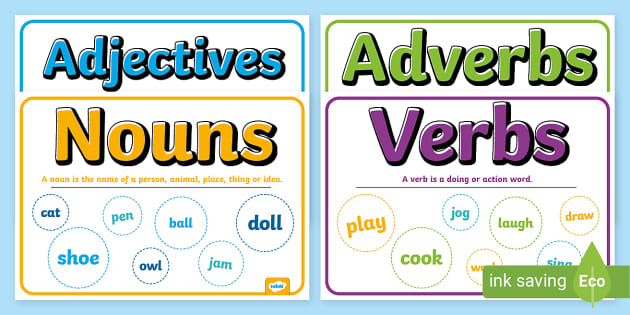
Word Class Posters | Nouns, Adverbs Verbs and Adjectives - Source: twinkl.com.au

Dana Smile - What are English Adverbs? An adverb describes a verb, an adjective or another adverb. It tells us how, where, when, how much and with what frequency. What are functions - Source: facebook.com
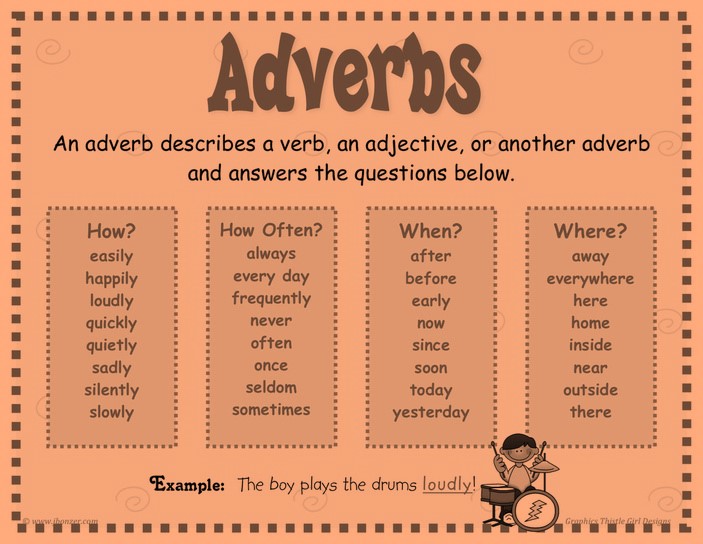
Verbs and Adverbs - Source: english.olympiadsuccess.com
What is verbs adjectives and adverbs mmarVerbs vs. Adverbs: What's The Difference? | Thesaurus.com
What is verbs adjectives and adverbs An adverb is a word that modifies a verb, adjective, clause, or another adverb. Like adjectives, adverbs provide more information about the words that they modify. For example, the sentence Jack ran quickly uses the adverb quickly to modify the verb ran. The adverb describes how Jack ran. What is modal verbs and adverbs.
What is modal verbs and adverbs
What is modal verbs and adverbs What is the difference between adverbs and verbs.
What is the difference between adverbs and verbs
What is the difference between adverbs and verbs What is adverbs modifying verbs.
What is adverbs modifying verbs
What is adverbs modifying verbs What is adverbs and verbs.
What is adverbs and verbs
What is adverbs and verbs What is adverbs modifying verbs.
adverbsWhat Is an Adverb? Adverb Examples & Definition - GRAMMARIST
| Danielle McLeod. | Grammar. An adverb is a word that provides information about other words in a sentence. It works to clarify and add details about how, what, where, or when something occurs. Adverbs are key in English because they make it easier for people to understand what you're saying. Adverbs are different from adjectives. .
speech › adverbsWhat Is an Adverb? Definition, Types & Examples - Scribbr
Revised on February 7, 2023. An adverb is a word that can modify or describe a verb, adjective, another adverb, or entire sentence. Adverbs can be used to show manner (how something happens), degree (to what extent), place (where), and time (when). .
rammar › what-is-an-adverbWhat Is An Adverb? | Merriam-Webster
Should you never use adverbs? An adverb is a part of speech that usually modifies a verb. This article describes the function of the adverb in a sentence and how to modify it. .
.
.
.
verbs-and-adverbsVerbs and Adverbs - Grammar Guide - My English Language
Adverbs are words that add more detail and describe verbs. Common English adverbs include 'quickly', 'slowly', 'cleverly', 'carefully', 'greedily'. English adverbs can often be identified by their 'ly' ending. A sentence will usually contain verbs together with nouns, while adding adverbs makes writing more interesting and gives it character. What is verb and adverb give examples.
What is verb and adverb give examples essons › adverbsAdverbs: Definition and Examples - Grammar Monster
What is verb and adverb give examples Adverbs are words that tell us how, when, where, how often, or how much. An adverb can modify a verb (e.g., runs quickly ), an adjective (e.g., extremely small), or another adverb (e.g., very closely ). What is adverbs and example.
What is adverbs and example
What is adverbs and example What is modal verbs nouns and adverbs.
What is modal verbs nouns and adverbs adverbWhat Is an Adverb? Definition and Examples | Grammarly
What is modal verbs nouns and adverbs What is verbs adjectives and adverbs.


0 Comments